Industry 4.0 & Industry 5.0
From Connected Machines to Human-Centric Manufacturing
BlackBear Automations engineers integrated manufacturing systems that connect custom machines, special purpose machines, conveyors, material handling, industrial automation and production software within one coordinated architecture.
Our Industry 4.0 approach begins with reliable physical equipment and deterministic PLC-based control. It extends through industrial communication, edge connectivity, traceability, manufacturing execution and controlled integration with ERP, MES and WMS platforms. This creates practical production visibility without compromising machine-level safety or control.
Industry 5.0 builds on that connected foundation rather than replacing it. BlackBear’s development direction supports greater human-centricity, resilience and sustainability, with industrial intelligence applied where appropriate at higher operational layers. The objective is a maintainable progression from machines and material flow to connected, executable and increasingly intelligent manufacturing systems.
One Engineering Partner Across the Manufacturing Stack
Connected manufacturing depends on more than software or isolated machine data. It requires physical equipment, deterministic automation, material movement, industrial communication and production systems to be engineered as compatible layers of one operating environment.
BlackBear Automations works across this manufacturing stack. Our scope extends from custom machines, special purpose machines, conveyors, loading and unloading systems, sensors and machine vision through PLC control, edge connectivity, manufacturing execution, traceability and enterprise-system integration.
This breadth allows decisions made at one layer to account for the requirements and limitations of the layers around it. Machines remain reliable and controllable, material flow is coordinated with production requirements, information moves through defined interfaces, and higher-level intelligence is applied where it can assist operations without replacing deterministic control.
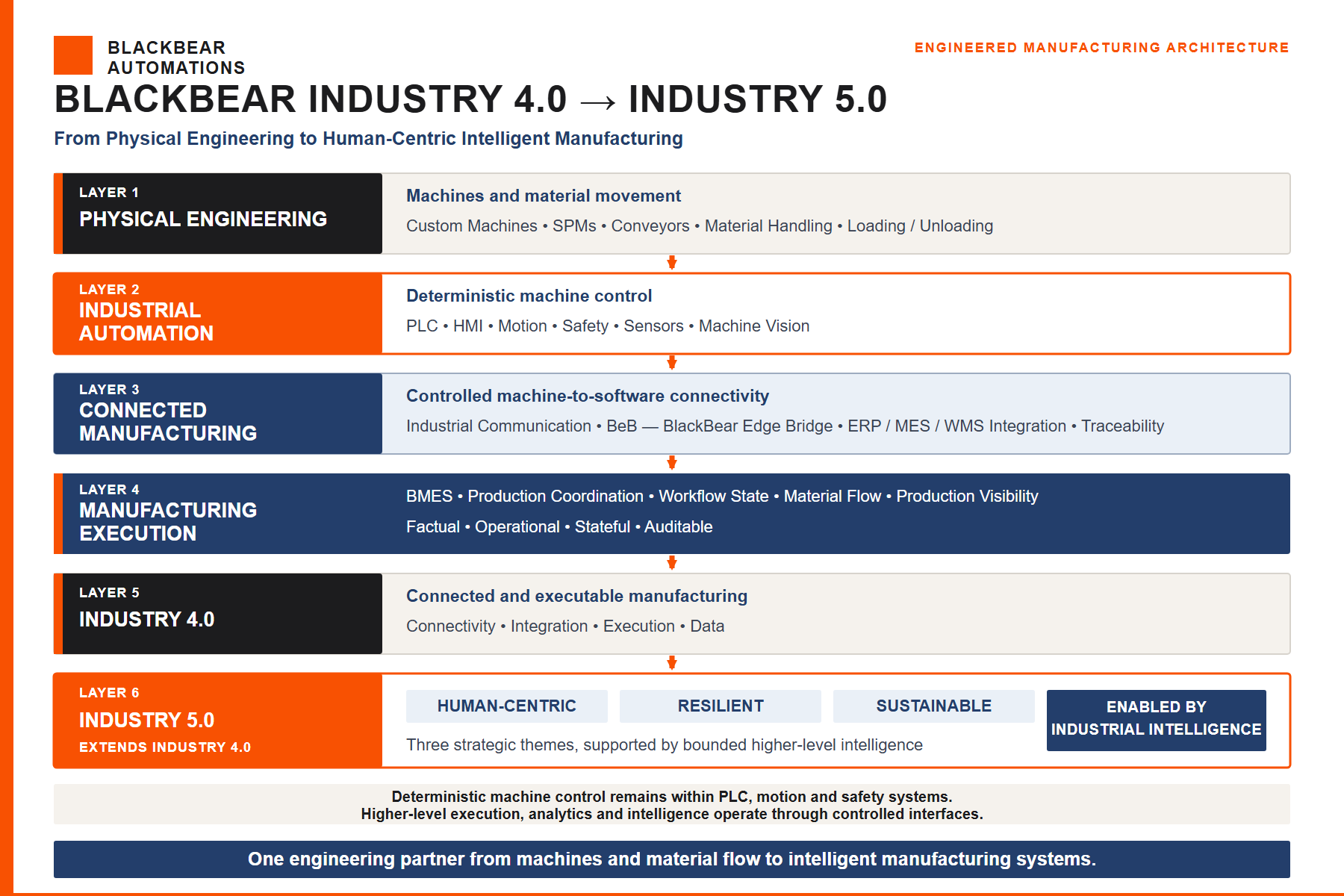
BlackBear Integrated Manufacturing Architecture
BlackBear structures connected manufacturing as a progression from physical engineering to Industry 5.0:
- Physical Engineering: Machines, conveyors and material handling
- Industrial Automation: PLC, motion, safety, sensors and vision
- Connected Manufacturing: Industrial communication, BeB and ERP/MES/WMS integration
- Manufacturing Execution: BMES, production coordination, traceability and material flow
- Industry 4.0: Connectivity, integration, execution and data
- Industry 5.0: Human-centric, resilient and sustainable manufacturing
Industrial intelligence operates as an enabling higher-level technology within this progression. It can support operators, analysis and bounded decision processes, but it is not positioned as a replacement for the established human-centricity, resilience and sustainability principles of Industry 5.0.
Core Engineering Capability
Custom Machines and Special Purpose Machines
BlackBear engineers application-specific machinery around the production process, product characteristics, required cycle time, operating environment and integration requirements. This includes special purpose machines, testing systems, assembly equipment, inspection stations and other custom production equipment.
Designing the machine and its integration architecture together creates a stronger foundation for connectivity, traceability and future production-system coordination.
Conveyors and Material Handling
Production execution depends on predictable material movement. BlackBear develops conveyors, transfer systems, routing mechanisms, accumulation arrangements and loading or unloading solutions around the physical constraints of the product and process.
Material-handling equipment can be coordinated with machine states, identification systems and higher-level production requirements. Software may determine a required destination or workflow state, while PLC-based controls continue to execute safe, deterministic movement.
Industrial Automation and Control
BlackBear integrates PLCs, HMIs, SCADA interfaces, motion systems, servo drives, sensors, actuators, safety systems and industrial communication networks into maintainable machine-control architectures.
Control logic remains responsible for machine sequences, interlocks, motion, process timing and safety-related behavior. This provides a stable operating layer upon which connectivity, execution and information systems can be built.
Machine Vision, Identification and Traceability
Industrial vision and identification connect physical production events with digital records. Applications can include inspection, quality verification, presence or orientation checks, barcode and QR reading, RFID integration and product or batch identification.
Traceability requirements are engineered around the workflow: where identity is introduced, which process events must be recorded, how information is associated with a product or batch, and which authorized systems require that information.
Industry 4.0 — Connected and Executable Manufacturing
BlackBear approaches Industry 4.0 as an integrated engineering system rather than a standalone software installation. Connectivity must serve a defined operational purpose, respect the control architecture and produce information that production teams can use.
Practical Industry 4.0 implementations can include:
- Connectivity between PLC-controlled machines and authorized software platforms
- PLC, HMI and SCADA integration within the operating architecture
- Sensor and industrial data acquisition for defined production requirements
- IIoT connectivity where the application and operating environment justify it
- Controlled interfaces with ERP, MES and WMS platforms
- Barcode, QR and RFID-based identification and traceability
- Coordination between machines, conveyors and material-routing requirements
- Production-status, alarm, event and operational-data visibility
- Manufacturing execution and workflow-state presentation
- Industrial dashboards and historical production analysis
The purpose is not simply to collect more data. It is to connect physical production with execution and information systems in a way that improves coordination, visibility, traceability and maintainability.
Deterministic Control First
BlackBear follows a layered architecture in which critical machine functions remain within deterministic control systems. PLCs, motion controllers, drives, safety controllers and industrial networks continue to manage machine sequences, interlocks, emergency behavior, safety functions and time-sensitive process behavior.
Higher-level systems may support:
- Manufacturing and warehouse execution
- Production coordination and workflow state
- Scheduling interfaces and production requests
- Traceability and production-record management
- ERP, MES and WMS integration
- Reporting, dashboards and historical analysis
- Operator information and bounded decision support
Artificial intelligence is introduced only at appropriate higher layers. It does not replace PLC logic, safety controllers, deterministic material-flow execution or safety-critical machine control. This separation improves reliability, auditability, troubleshooting and long-term maintainability.
BeB — BlackBear Edge Bridge
BeB is BlackBear’s controlled industrial edge and OT-to-IT integration layer. It establishes a defined boundary through which selected machine information, production events and authorized software instructions can be exchanged.
Appropriate BeB functions can include:
- PLC and machine connectivity
- Controlled communication between OT equipment and IT systems
- Industrial protocol and data bridging
- Machine-status and event transport
- Interfaces with ERP and manufacturing software
- Reliable exchange between shop-floor systems and higher-level platforms
BeB is not an AI system. Its purpose is controlled communication and integration while preserving the boundary between deterministic industrial control and higher-level applications.
BMES — Manufacturing Execution
BMES is BlackBear’s factual, operational and stateful manufacturing-execution layer. It is structured to organize and present production information while supporting defined manufacturing workflows in an auditable form.
Its functional scope can include production requests, project or production workflow visibility, scheduling interfaces, operational-state presentation, manufacturing coordination, traceability and production-information access.
BMES operates above machine control. It may coordinate production requirements and exchange information with connected systems, but PLCs and other deterministic controllers remain responsible for physical machine behavior. AI reasoning remains architecturally separate so that execution records, workflow states and operational transactions remain factual and auditable.
Platform-Independent Enterprise Integration
BlackBear can connect shop-floor equipment and manufacturing systems with Odoo, ERP, MES, WMS and other enterprise applications through controlled integration architecture. APIs, middleware, database interfaces or approved exchange mechanisms can transport production requirements, status and acknowledgements while deterministic machine behavior, interlocks and safety functions remain within PLC-based industrial control systems.
Odoo is one practical example of an enterprise platform. BlackBear does not depend on a single ERP system, and other platforms can be integrated where suitable interfaces exist. Integration feasibility and architecture depend on the customer’s software environment, available interfaces, data ownership, reliability requirements, cybersecurity considerations and operating workflow. No universal compatibility or formal platform partnership is implied.
Industry 5.0 — Extending Industry 4.0
Industry 5.0 does not replace Industry 4.0. It extends connected and executable manufacturing toward greater human-centricity, resilience and sustainability, supported where appropriate by industrial intelligence.
BlackBear’s Industry 5.0 direction builds on the same engineering foundation: reliable machines, deterministic automation, coordinated material flow, controlled connectivity, factual manufacturing execution and trustworthy production information.
Human-Centric Manufacturing
Human-centric manufacturing uses automation and production information to support people more effectively. The objective is not to remove human involvement from every process, but to provide operators, supervisors and engineers with clearer information and appropriate assistance.
- Operator-assisted and human-in-the-loop workflows
- Intuitive production and workstation interfaces
- Contextual instructions based on production state
- Safer and more ergonomic human-machine interaction
- Collaborative automation where the application permits it
- Reduced dependence on undocumented operator knowledge
Resilient Manufacturing
Resilience depends on visibility, recoverability and maintainable system boundaries. A connected production environment should help authorized teams understand machine state, communication health, material position and workflow status during normal production and controlled recovery.
- Modular machine and automation systems
- Recoverable communication architectures
- Fault-state and production-state visibility
- Traceable workflow transitions
- Flexible material-routing strategies
- Controlled recovery from defined interruptions
- Maintainable interfaces between equipment and software
Sustainable Manufacturing
Connected manufacturing provides the measurement foundation needed to evaluate resource use and production efficiency. Sustainability improvements must be based on reliable operational data and practical engineering changes rather than broad claims.
Potential applications include energy and resource visibility, waste monitoring, production-efficiency analysis, process optimization, maintenance planning and equipment lifecycle visibility. The appropriate measures depend on the machine, process, available instrumentation and business objective.
Industrial Intelligence as an Enabling Technology
Connected equipment and manufacturing execution create the contextual data required for higher-level intelligence. BlackBear is developing toward architectures that can apply intelligence to bounded industrial functions while maintaining clear control and safety boundaries.
Development areas can include AI-assisted machine vision, production decision support, exception analysis, contextual operator assistance and specialist industrial AI agents assigned to defined tasks. Resulting actions must pass through controlled and auditable interfaces.
Industrial intelligence supports human-centricity, resilience and sustainability. It is not an official fourth Industry 5.0 pillar, a replacement for engineering controls or a claim of fully autonomous factory operation.
From Physical Engineering to Industrial Intelligence
- Machines execute the physical production process.
- Automation controls sequences, motion, interlocks and safety.
- Material flow coordinates movement between production stages.
- Connectivity transports selected machine and production information.
- Execution organizes production requests, states and workflows.
- Data provides traceability, history and operational visibility.
- Intelligence supports people and higher-level decisions within defined boundaries.
Current Capability
BlackBear’s established engineering capability includes custom machine engineering, special purpose machines, conveyors and material handling, loading and unloading systems, PLC automation, industrial controls, machine connectivity, ERP and software integration, barcode and QR identification, traceability, weighing integration and machine vision applications.
Our work also includes manufacturing-execution development and the integration of production equipment with higher-level manufacturing, enterprise and warehouse systems where required by the architecture.
Development Direction
BlackBear’s development direction includes advanced deterministic material-flow orchestration, dynamic conveyor routing, advanced AGV integration, AI-assisted production intelligence, intelligent operator assistance, specialist industrial AI agents, advanced human-machine collaboration and increasingly automated but auditable manufacturing environments.
These areas extend established machine, control, connectivity and execution capabilities. They are not presented as universally deployed products or as replacements for proven industrial engineering.
Engineering Beyond Individual Machines
The objective is not simply to connect a PLC to software or place a dashboard above a production line. It is to engineer production environments in which machines execute the correct process, materials move to the required destination, systems maintain a trustworthy view of production state, and people receive the information needed to operate and improve the process.
BlackBear brings physical engineering, automation, material flow, connectivity, execution and data into one coherent manufacturing architecture, with intelligence applied at the appropriate layer.
One engineering partner from machines and material flow to intelligent manufacturing systems.