Warehouse Management & Intralogistics Systems
Warehouse Software Connected to Physical Material Flow
BlackBear Automations engineers warehouse management and intralogistics systems that connect inventory information with the physical movement of material. Our approach combines configurable warehouse software, structured SKU and location management, barcode or QR identification, ERP integration, conveyors, weighing systems and PLC-controlled material-handling equipment.
The system establishes what material is available, where it is stored, what must happen next and how each movement will be confirmed. Operators receive clear receiving, put-away, picking and dispatch instructions without depending entirely on personal knowledge of the warehouse.
Automation is selected according to the material, transaction volume, warehouse layout, required throughput and investment justification. Whether the operation is primarily manual, assisted or conveyor-integrated, BlackBear treats inventory accuracy, identification, workflow, traceability and physical movement as parts of one engineered warehouse system.
Warehouse Management Beyond Inventory Software
A warehouse management system is effective only when its digital records correspond to physical reality. Inventory data must identify what material is available, while the operating process must establish where that material is stored, how it is identified, what must happen next and how each movement is executed and confirmed.
BlackBear Automations approaches warehouse management as an engineering problem that connects software, identification, material flow, industrial automation and enterprise systems. The scope can extend from SKU and location architecture through receiving, labeling, put-away, inventory visibility, picking and dispatch to conveyors, weighing stations, loading systems and PLC-controlled material handling.
The objective is not to impose the same workflow or automation level on every facility. BlackBear develops a configurable operating architecture around the warehouse size, product characteristics, transaction volume, physical layout, business process and required integration.
Warehouse Operating Architecture
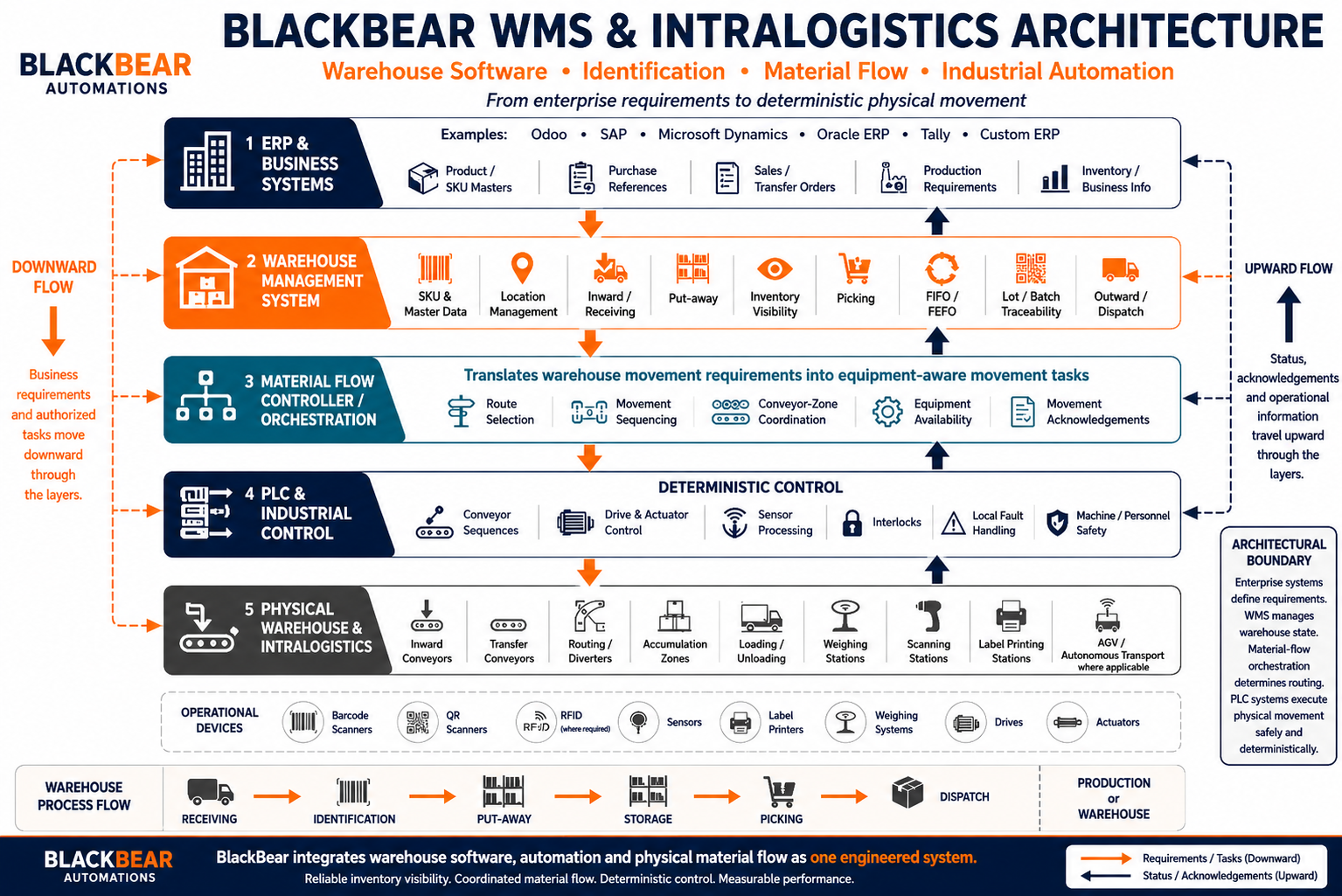
- ERP or business systems such as Odoo or other suitable platforms provide relevant product, purchasing, sales, transfer, production and business references through approved interfaces.
- The warehouse management system manages inventory identity, location, warehouse workflow, source, destination and transaction state.
- The material-flow controller or orchestration layer coordinates routing, movement sequence, conveyor zones, equipment availability and acknowledgements.
- PLC-controlled conveyors and equipment execute physical movement, local machine behavior, interlocks and safety functions.
- Operational devices such as sensors, scanners, printers, drives, actuators and weighing systems interact with physical material.
The WMS determines what material must move, its source and destination, and the relevant business or warehouse state. Material-flow orchestration converts that requirement into equipment-aware movement tasks. PLC-based controls execute physical behavior safely and deterministically.
SKU and Location Management
A dependable warehouse begins with structured master data. BlackBear can configure product or SKU records around required product attributes, storage requirements, owner or business-unit information, barcode identifiers and lot or batch details.
Physical locations can use a configurable hierarchy such as warehouse, zone, rack, bay, level and bin. A smaller facility may use only part of this hierarchy, while a multi-location operation may require additional warehouse, branch or business-unit separation.
Every managed storage position should have a defined identity used consistently in software, physical signage, labels, scanning workflows and operator instructions.
Inward and Receiving
Inward processing establishes the first reliable connection between received material and warehouse inventory. The workflow can begin with a purchase reference, transfer document, advance shipment information or manually authorized receipt.
- Goods-receipt registration and reference verification
- Quantity confirmation and exception recording
- Product, lot or batch identification
- Barcode or QR label generation where required
- Temporary staging-location assignment
- Storage-location suggestion
- Put-away task creation and confirmation
Scanners, label printers, weighing systems and verification stations can be incorporated where required. The workflow should reflect packaging level, transaction volume, product characteristics and traceability requirements.
System-Assisted Put-Away
Put-away converts received inventory into accurately located, available stock. BlackBear can configure location suggestions using available storage positions, SKU characteristics, warehouse zoning, storage rules and operating constraints.
The operator can be directed to a specific rack, shelf or bin and confirm the movement through barcode-assisted steps. Exceptions such as an occupied location, identification mismatch or unsuitable position return to the workflow for controlled resolution.
This is rules-based warehouse engineering rather than a claim of universal AI-driven slotting. Adaptive slotting recommendations form part of BlackBear’s development direction where sufficient data and operational justification exist.
Inventory Visibility
A configured BlackBear warehouse platform can present inventory by SKU, warehouse or branch, location, lot, batch and movement status according to project requirements. Authorized users can determine whether material is available, staged, allocated, in movement or awaiting confirmation.
Inventory visibility depends on disciplined transactions. Software accuracy cannot compensate for unrecorded movements, incorrect labeling or uncontrolled storage practices. The operating process and system workflow must be designed together.
Picking and Order Consolidation
System-guided picking translates order or production demand into warehouse instructions identifying the required SKU, selected stock, source location, quantity and destination or consolidation point.
Barcode verification can confirm that the operator is at the correct location and has selected the intended material. Pick confirmations and exceptions update the workflow so inventory and order state remain aligned.
Structured location instructions reduce dependence on operator memory and can support order consolidation, branch transfers, production supply and staged dispatch.
Outward and Dispatch
Outward operations can include order preparation, pick confirmation, item or carton verification, consolidation, packing, staging, customer or branch allocation and final dispatch confirmation.
Identification controls are applied at the level justified by the process. Some operations require carton verification, while others require individual-item, lot or batch confirmation. Dispatch information can return to an ERP or business system through an approved interface.
FIFO, FEFO and Traceability
FIFO can prioritize older received stock, while FEFO can prioritize material according to expiry information when expiry-based handling is relevant. FEFO is not necessary for every warehouse and should be applied only where product and operating rules justify it.
Traceability can connect the SKU, lot, batch, inward receipt, storage location, warehouse movement, picking event and dispatch transaction. The required depth depends on regulatory, customer, quality and operational requirements.
Barcode, QR and Identification
Identification forms the operational connection between physical material and warehouse software. BlackBear can integrate handheld scanners, fixed scanners, barcode or QR labels, label printers and verification stations into warehouse workflows.
The identification strategy depends on packaging level, transaction volume, product characteristics, process and customer requirements. RFID can be considered when justified, but it is not treated as the default solution.
ERP and Business-System Integration
BlackBear can integrate warehouse operations with Odoo and other ERP, MES, WMS, accounting, sales and customer-specific enterprise platforms through APIs, databases, middleware, file-exchange mechanisms or other suitable controlled interfaces.
Typical information exchange can include:
- Product and SKU master data
- Purchase references and goods-receipt information
- Sales orders and transfer orders
- Production and warehouse requirements
- Inventory status
- Lot and batch information
- Dispatch and production confirmation
- Transaction acknowledgements
- Relevant operational status
BlackBear does not depend on a single ERP platform. Integration may involve Odoo, SAP, Microsoft Dynamics, Oracle ERP, Tally-connected workflows or custom ERP and business applications. Architecture is selected according to available interfaces, data ownership, response-time and reliability requirements, cybersecurity considerations and operational workflow.
Integration feasibility depends on the interfaces available in the customer’s existing software environment. No universal compatibility or formal platform partnership is implied.
Within the BlackBear architecture, Odoo and other ERP platforms remain at the enterprise layer and do not directly control motors, drives, PLC sequences, conveyors, safety systems or deterministic equipment behavior.
Intralogistics and Conveyor Integration
BlackBear can engineer both warehouse software and physical material-flow equipment. Where automation is justified, the architecture can integrate inward and outward conveyors, transfer conveyors, accumulation zones, diverter stations, scanning stations, weighing stations, label-printing stations, packing or verification stations, loading and unloading systems, and staging areas.
AGVs or autonomous transport platforms can be incorporated where the project scope, available interfaces, traffic-control architecture and safety requirements support their integration.
Not every warehouse requires automated movement. The appropriate level is selected using transaction volume, material type, layout, throughput, manpower availability, maintainability and investment justification.
Material-Flow Control
Warehouse Management System
- What material must move
- Source location
- Destination
- Relevant business and warehouse state
Material-Flow Orchestration
- Routing
- Conveyor-zone coordination
- Movement sequencing
- Equipment availability
- Movement acknowledgements
PLC-Controlled Equipment
- Physical conveyor and equipment sequences
- Sensor processing
- Drive and actuator control
- Equipment interlocks
- Local fault handling
- Machine and personnel safety
Artificial intelligence does not replace safety logic, emergency behavior, PLC sequences or deterministic routing functions that require guaranteed execution.
Production-to-Warehouse Integration
BlackBear can engineer interfaces between production lines, finished-goods identification, transfer equipment, storage locations, picking operations, dispatch processes and enterprise systems.
- Production completes or releases identified material.
- Identification associates it with the required product, batch or transaction.
- Transfer moves it through manual or automated handling.
- Storage assigns and confirms its warehouse location.
- Picking retrieves it against production, transfer or customer demand.
- Dispatch verifies and confirms its outward movement.
Deterministic Automation First
PLCs, drives, sensors, safety controllers and industrial networks manage physical equipment behavior and time-sensitive sequences. Warehouse software coordinates inventory, tasks, locations, orders and transaction state. Optional analytics or AI assistance remains above deterministic control and operates through defined interfaces with bounded authority.
This separation improves reliability, troubleshooting, auditability and recovery while preserving responsibility for machine safety and local control.
A Warehouse Designed for Fast Product Location
A central design objective is that a new employee should be able to locate the required product quickly without depending entirely on the memory of an experienced storekeeper. This is an operating principle rather than a guaranteed service level.
It requires accurate SKU master data, structured location coding, clear rack, shelf and bin identification, searchable inventory locations, barcode-assisted transactions, disciplined receiving and put-away, and operator-friendly picking instructions.
Current Engineering Capability
BlackBear’s established capability includes warehouse-process engineering, inventory-location architecture, custom warehouse software, barcode and QR workflows, scanner and printer integration, ERP and software interfaces, conveyors, material handling, weighing systems, PLC automation, machine connectivity, production and warehouse integration, and transaction traceability.
Project scope is selected according to actual requirements; a warehouse-software project does not automatically imply conveyor automation, and an equipment project does not require unnecessary software complexity.
Development Direction
BlackBear’s development direction includes advanced deterministic material-flow orchestration, dynamic conveyor routing, advanced AGV integration, warehouse analytics, AI-assisted operator support, adaptive slotting recommendations, intelligent exception analysis, natural-language access to authorized warehouse information and increasingly automated but auditable warehouse execution.
These roadmap capabilities are higher-level assistance and execution developments, not replacements for verified transactions, disciplined processes or deterministic equipment control. They are not presented as universally deployed products.
Connection to Industry 4.0 and Industry 5.0
Warehouse execution is one component of BlackBear’s connected-manufacturing architecture. Machines and production create or consume identified material, material flow coordinates physical movement, the warehouse manages inventory and execution state, and ERP or enterprise systems coordinate relevant business requirements.
Industry 4.0 connects identification, inventory, workflow and material movement with production and business information. Industry 5.0 extends this foundation toward human-centricity, resilience and sustainability, supported where appropriate by higher-level industrial intelligence.
Engineering Beyond Warehouse Software
Effective warehouse management requires digital inventory accuracy, physical location discipline and a controlled method for converting a software task into an operator instruction or equipment movement and returning a trustworthy confirmation.
Inventory knows where the material is. The workflow knows what must happen next. The material-flow system knows where it must move. PLC-controlled equipment executes that movement safely and deterministically.
BlackBear integrates warehouse software, automation and physical material flow as one engineered system.